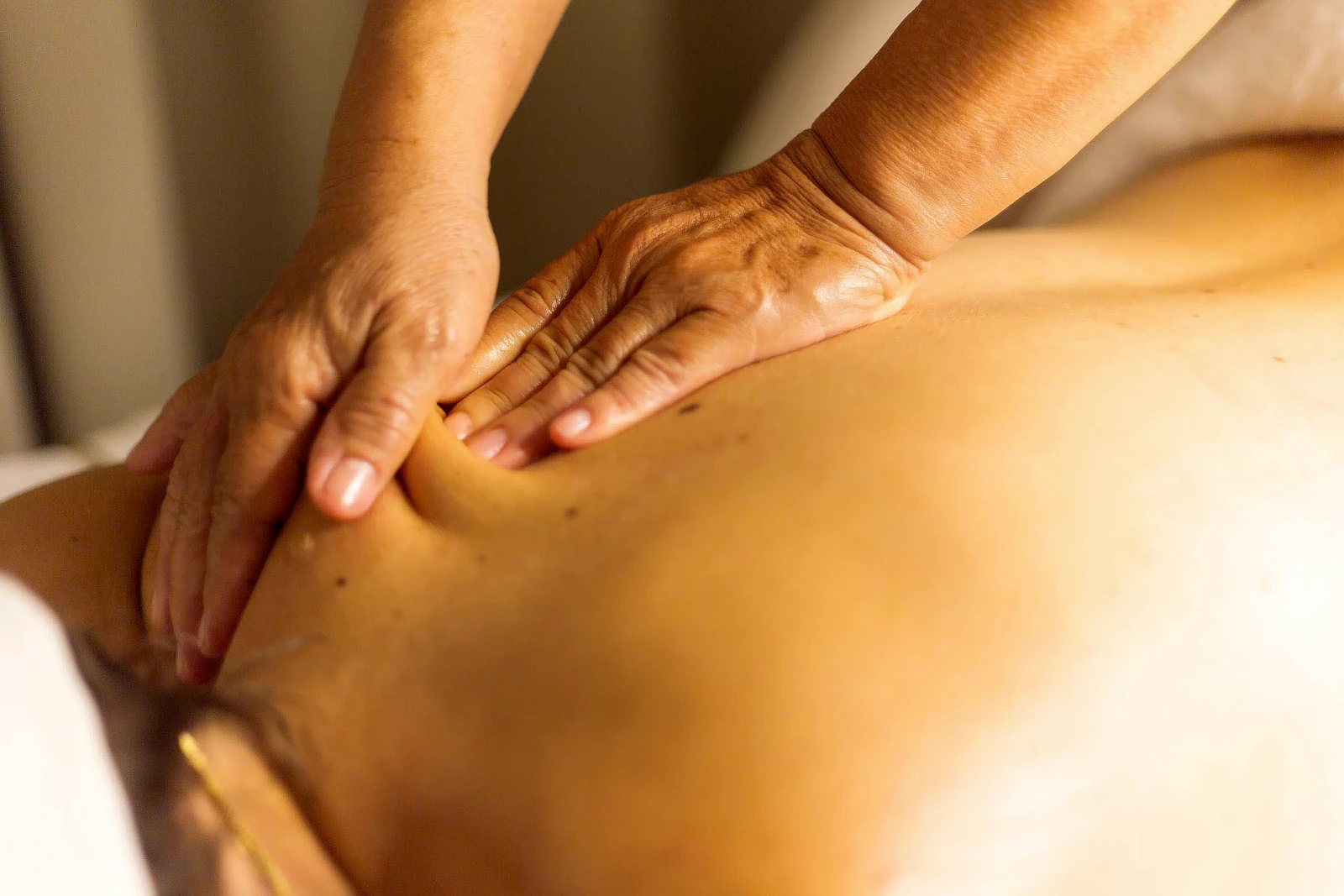
Deep Tissue Massage
Slow, sustained pressure into the deepest muscle layers and fascia. For chronic tension that doesn't release with regular massage — knots that have been there for months, restricted movement, deep stiffness that won't go away.
First visit discount applied automatically · Includes consultation & herbal tea
What Deep Tissue Massage Actually Is
Deep tissue massage is a slow, focused technique that works into the deepest layers of muscle and fascia (the connective tissue that wraps every muscle, bone, and organ). Unlike relaxation massage which glides over the surface, deep tissue sinks in — using sustained pressure with thumbs, knuckles, forearms, and elbows to reach structures that lighter techniques cannot access.
The key word is slow. Deep tissue is not "harder Swedish massage." The strokes move slowly — sometimes spending minutes on a single area — gradually working through the superficial layers to reach the deep tissue beneath. This is what allows the therapist to release chronic adhesions (bands of rigid tissue that form between muscle fibres after injury, overuse, or prolonged tension) without causing tissue damage.
At Namm Massage, deep tissue sessions focus on your specific problem areas. You tell us where the chronic tension lives — the therapist spends the session there, not spreading attention across the full body. This is targeted, therapeutic work.
What It Is Not
Deep tissue massage is not the same as sport massage. Sport massage is dynamic — multiple techniques in rapid sequence (kneading, tapotement, squeezing, joint movements), designed for athletic recovery. Deep tissue is the opposite: slow, sustained, local, working into one area until the tissue releases. If you need post-workout recovery, choose Sport Massage. If you have a chronic knot that hasn't responded to regular massage, deep tissue is the right choice.
It is also not "just stronger pressure." Many places advertise deep tissue but simply push harder with a standard oil massage technique. Real deep tissue massage uses specific strokes — stripping (slow, deep gliding along the muscle fibre), cross-fibre friction (pressure applied across the grain of the muscle), and sustained trigger point compression. The depth comes from technique and time, not from brute force.
Deep tissue can be intense — you will feel the work, especially on dense, long-held tension — but it should never cause sharp pain or bruising. At Namm you choose the pressure on a 5-level scale. Level 5 is reserved for guests who specifically request maximum depth on well-identified problem areas.
-
01
Chronic Tension That Won't Release
That knot between the shoulder blades that has been there for months. The tight band across the upper traps that regular massage loosens for a day before it locks up again. Deep tissue works into the layer where these chronic patterns live — the fascia and deep muscle fibres that surface techniques cannot reach.
-
02
Restricted Range of Motion
Shoulder that won't fully rotate. Neck that can't turn to one side. Lower back that seizes when you bend. Fascial adhesions and chronic muscle contracture limit movement. Deep tissue's cross-fibre friction and sustained pressure work to restore mobility to tissue that has become rigid.
-
03
Old Injuries & Scar Tissue
Previous muscle tears, strains, or injuries leave scar tissue that is denser and less elastic than the original muscle. Deep tissue massage can gradually improve the pliability of this tissue, reducing the pulling sensation and stiffness that old injuries leave behind.
-
04
Lower Back & Lumbar Tightness
The quadratus lumborum and erector spinae muscles in the lower back hold tension that lighter massage barely touches. Deep tissue's sustained elbow and forearm work on these deep structures is one of the most effective manual approaches for chronic lumbar stiffness.
-
05
When Regular Massage Isn't Enough
If you've been getting oil massage, Thai massage, or relaxation massage and the tension keeps coming back within days — the issue likely sits deeper than those techniques reach. Deep tissue goes to the layer they don't.
-
→
Not Sure If You Need Deep Tissue?
Tell us what you feel, how long you've had it, and what you've tried — we'll recommend the right approach. Ask via WhatsApp
The Session — Stage by Stage
Every session begins with a focused consultation. Deep tissue is the most targeted service at Namm — we need to know exactly where the problem is, how long you've had it, and what makes it worse. The therapist maps your tension areas before the session starts.
Stage 1 — Warm-up effleurage with oil. Light-to-medium strokes to warm the superficial muscle layers and prepare the tissue for deep work. Oil is applied to reduce friction — deep tissue requires smooth, sustained contact. This phase is gentle; the intensity builds gradually.
Stage 2 — Stripping. Slow, deep gliding strokes along the muscle fibres using thumbs, knuckles, or forearm. The therapist sinks into the tissue and moves along the length of the muscle, feeling for adhesions, dense bands, and trigger points. Each stroke may take 10–15 seconds. This is the core technique.
Stage 3 — Cross-fibre friction. Pressure applied across the grain of the muscle — perpendicular to the fibre direction. This technique specifically targets fascial adhesions and scar tissue, breaking down the rigid bands that restrict movement. Intense but controlled.
Stage 4 — Trigger point compression. When the therapist finds a trigger point (a hyperirritable knot within a taut band of muscle), they apply sustained, static pressure — typically 10–30 seconds — until the tissue softens and the referred pain pattern subsides. You may feel the sensation radiate to another area; this is normal trigger point referral.
Stage 5 — Elbow and forearm work. On large, dense muscle groups — the erector spinae, gluteals, quadriceps, hamstrings — the therapist uses the forearm and elbow to deliver broad, sustained pressure that thumbs alone cannot sustain. This is where levels 4 and 5 on the pressure scale come into play.
Stage 6 — Finishing effleurage. Light strokes to settle the tissue. The worked area may feel warm, tender, and significantly looser than when you arrived.
After the session — herbal tea, cold water, hydration advice, and a recommendation on when to return for follow-up.
What's Included
- ·
Detailed consultation & tension mapping
We identify your specific problem areas before the session starts. Deep tissue is targeted, not generalized.
- ·
Private, air-conditioned room
Fresh linen for every guest. Strict silence policy. 5-level adjustable pressure.
- ·
Certified therapist
Trained in deep tissue techniques — stripping, cross-fibre friction, trigger point compression. Not improvised "harder massage."
- ·
Massage oil
Applied for smooth, sustained contact — deep tissue requires uninterrupted glide through the tissue.
- ·
Hot Thai herbal tea after
Time to rest before stepping back into your day.
- ·
Aftercare & follow-up guidance
Hydration advice, stretching recommendations, and when to return for the next session.
Deep tissue massage is intensive — you will feel the work, especially on areas with chronic tension, adhesions, or trigger points. The sensation during trigger point compression is often described as "good pain" — intense but relieving, like pressing on a bruise that needed pressing. It should never feel like sharp, stabbing, or unbearable pain. At Namm you control the pressure on a 5-level scale and can adjust at any moment. For first-time deep tissue guests we recommend starting at level 3–4.
Sport massage is dynamic — fast, varied techniques (kneading, tapotement, squeezing, joint movements) designed to recover muscle tone after athletic load. Deep tissue is the opposite: slow, sustained, focused on one area at a time, working into the deepest muscle layers and fascia to release chronic tension. Sport massage is for recovery after effort; deep tissue is for chronic problems that don't respond to regular massage.
It can be, but most guests benefit more from a targeted session. Deep tissue works best when the therapist spends concentrated time on your specific problem areas rather than spreading attention across the full body. In the consultation we'll identify your priority zones and focus there. If you want full-body coverage with deep pressure, the 120-minute session allows time for both targeted problem-area work and broader coverage.
Mild soreness in the treated areas for 24–48 hours after a deep tissue session is normal — similar to post-workout muscle soreness. This is the tissue response to the deep work and resolves on its own. Drink plenty of water, avoid heavy exercise for 24 hours, and apply light stretching. If soreness persists beyond 48 hours or if you notice bruising, the pressure was too deep — let us know for your next session.
For chronic tension — once a week for 3–4 weeks, then reassess. For maintenance after the initial course — once every 2–4 weeks. Deep tissue is cumulative: each session builds on the previous one, gradually releasing tissue that has been rigid for months or years. A single session can provide relief, but lasting change typically requires a series.
A trigger point is a hyperirritable spot within a taut band of muscle — what most people call a "knot." When pressed, it produces local pain and often referred pain in a predictable pattern (for example, a trigger point in the upper trapezius can refer pain up into the base of the skull, causing a headache). Deep tissue massage uses sustained compression on trigger points until the tissue softens and the pain pattern resolves.
60 minutes — focused work on one problem area (neck and shoulders, or lower back, or one leg). Best for a single specific issue. 90 minutes — two or three problem areas with thorough attention to each, the most popular choice. 120 minutes — comprehensive session covering multiple problem areas or combining deep targeted work with broader full-body coverage.
Walk-in massage is welcome every day from 10:00 to 22:00. For a course of deep tissue sessions, we recommend booking your full schedule via WhatsApp so we can assign the same therapist for continuity — the therapist who knows your tension map gives better results than starting fresh each time.